Metal fabrication machinery, tooling, parts & service in NY, PA, NJ, DE, MD and WV
China Top 10 Fabrication Cutting Machine Manufacturers?
Choosing among China’s top 10 fabrication cutting machine manufacturers requires more than comparing prices. A busy workshop needs stable accuracy, reliable motion control, and responsive technical support. Imagine a 6,000 mm steel plate moving beneath a CNC plasma torch. Small positioning errors can produce costly scrap, delayed orders, and uneven edges. Laser, plasma, oxy-fuel, and fiber cutting systems each suit different materials, thicknesses, and production speeds.
James F. Lincoln, a respected welding-industry educator, said, “The quality of a product is the direct reflection of the quality of the process that produced it.” His observation remains relevant when evaluating Chinese machine builders. A trustworthy manufacturer should explain its cutting tests, component brands, software functions, safety systems, and maintenance requirements clearly. It should also provide measurable information about repeatability, power consumption, consumables, and after-sales training.
This guide examines ten notable Chinese manufacturers through practical criteria. These include engineering experience, factory capability, export performance, product range, customization, certifications, and customer service. Factory demonstrations matter. So do clean cable routing, rigid machine frames, protected guide rails, and consistent sample cuts. Promotional claims can sound impressive. They are not always enough.
Buyers should question every ranking. The lowest quote may hide installation costs, weak documentation, or difficult spare-parts access. A higher initial investment may reduce downtime over several years. Still, no manufacturer fits every workshop. Material type, plate thickness, floor space, order volume, and operator skill must shape the final decision. This overview offers a practical starting point, not an unquestionable verdict.
What Are Fabrication Cutting Machines and How Are They Classified?
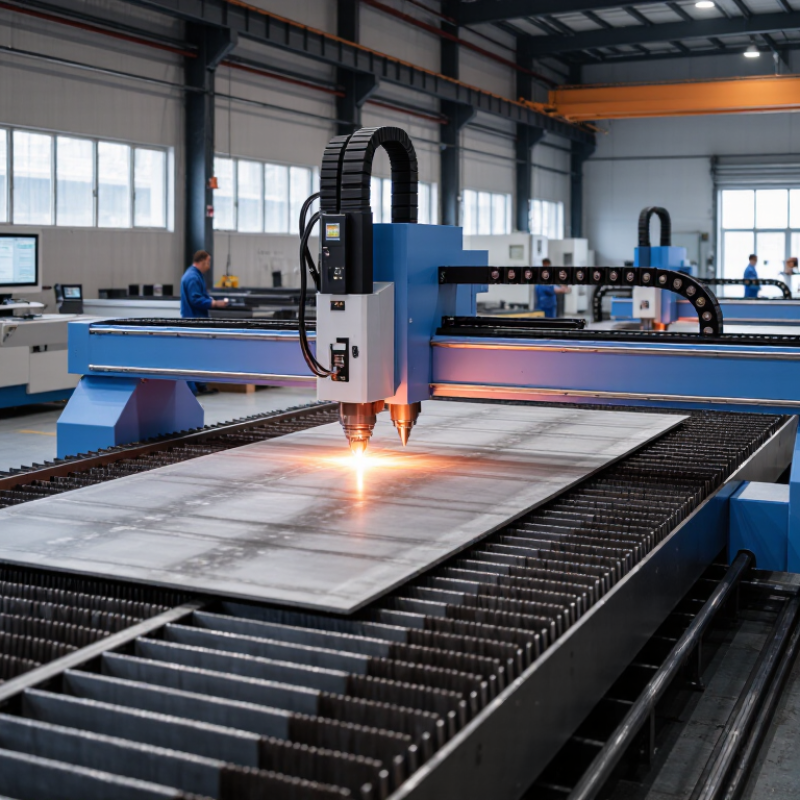
Fabrication cutting machines are industrial systems that separate metal or other materials into usable parts. They process sheets, plates, tubes, and structural sections. A machine normally combines a cutting source, motion system, worktable, control unit, and fume or waste management. The cutting source creates the main classification.
Laser machines use a focused light beam for clean edges and tight tolerances. Plasma systems cut conductive metals quickly, especially medium and thick plate. Oxy-fuel machines rely on heat and oxidation, making them practical for heavy carbon steel. Waterjet machines use high-pressure water, sometimes with abrasive particles, and produce little heat-affected distortion. The edge may still need cleaning.
Machines can also be classified by movement and automation. Flatbed models cut two-dimensional sheets. Tube and profile systems rotate or reposition long workpieces. Three-axis machines suit basic shapes, while five-axis systems handle bevels and complex angles. Manual, semi-automatic, and CNC models differ in repeatability and operator involvement.
In daily production, I would check thickness, kerf width, edge quality, tolerances, and operating cost. A thick plate may favor plasma or oxy-fuel, while thin stainless steel may need laser or waterjet cutting. The fastest machine is not always the best choice. No classification is perfect. Material warping, nozzle wear, dust, and programming errors can change the result. Operators should verify trial cuts before full production.
China Top 10 Fabrication Cutting Machine Manufacturers? - What Are Fabrication Cutting Machines and How Are They Classified?
| No. | Machine Classification | Primary Cutting Technology | Typical Materials | Typical Thickness Range | Typical Accuracy | Common Fabrication Applications |
|---|---|---|---|---|---|---|
| 1 | Flat-Bed Fiber Laser Cutting Machine | High-power fiber laser with CNC motion control | Carbon steel, stainless steel, aluminum, brass and copper | 0.5–30 mm, depending on material and laser power | Approximately ±0.05–0.10 mm | Sheet-metal parts, enclosures, brackets, panels and structural components |
| 2 | CO₂ Laser Cutting Machine | CO₂ laser beam with focusing optics | Acrylic, wood, plastics, fabric, rubber and some coated metals | 0.1–25 mm for nonmetals; thin metals with suitable configuration | Approximately ±0.10–0.20 mm | Signage, interior components, templates, gaskets and decorative fabrication |
| 3 | CNC Plasma Cutting Machine | Ionized gas arc producing a high-temperature plasma jet | Mild steel, stainless steel, aluminum and conductive metals | 1–50 mm for common production work | Approximately ±0.20–0.50 mm | Heavy plate profiling, equipment frames, agricultural parts and steel structures |
| 4 | CNC Oxy-Fuel Cutting Machine | Oxygen-fuel flame preheating and oxidation cutting | Carbon steel and low-alloy steel | 6–300 mm or more for specialized heavy-plate systems | Approximately ±0.50–1.50 mm | Shipbuilding, bridges, heavy machinery and large structural steel parts |
| 5 | Abrasive Waterjet Cutting Machine | High-pressure water mixed with abrasive particles | Stone, glass, ceramics, metals, composites and heat-sensitive materials | 1–150 mm, with thicker sections possible at lower speed | Approximately ±0.10–0.25 mm | Aerospace parts, stone profiles, machine components and composite panels |
| 6 | CNC Router Cutting Machine | Rotating cutting tool mounted on a computer-controlled gantry | Wood, plastics, foam, composites, aluminum and nonferrous sheets | 0.5–50 mm per pass, depending on tool and material | Approximately ±0.10–0.30 mm | Cabinet parts, patterns, signage, molds and lightweight fabrication panels |
| 7 | CNC Tube and Pipe Laser Cutter | Fiber laser cutting with rotary or chuck-based tube positioning | Carbon steel, stainless steel, aluminum and galvanized tubing | Tube walls approximately 0.8–12 mm | Approximately ±0.05–0.15 mm | Furniture frames, handrails, vehicle components and welded assemblies |
| 8 | CNC Shearing Machine | Mechanical or hydraulic straight-line blade shearing | Carbon steel, stainless steel and aluminum sheet | Approximately 0.5–16 mm | Approximately ±0.10–0.50 mm | Straight cuts, blanks, strips and preparation for bending operations |
| 9 | CNC Nibbling and Punching Machine | Programmable punching or nibbling with interchangeable tooling | Mild steel, stainless steel and aluminum sheet | Approximately 0.5–6 mm | Approximately ±0.10–0.20 mm | Perforations, louvers, mounting holes, electrical cabinets and panels |
| 10 | CNC Guillotine and Profile Cutting Line | Integrated cutting, positioning and material-handling operations | Structural steel sections, plates, channels, angles and bars | Approximately 3–100 mm, depending on the cutting module | Approximately ±0.30–1.00 mm | Construction steel, storage systems, industrial frames and prefabricated structures |
Note: Thickness, speed and accuracy ranges are typical industry values and vary according to machine configuration, material grade, workpiece geometry, tooling, consumables and operating conditions.
Related Posts
-
Why Choose an Air Plasma Arc Cutting Machine for Your Projects?
-
2026 Top Plasma Cut Machine Innovations and Trends to Watch Out For?
-
10 Essential Tips for Choosing the Right Plasma Cut Machine?
-
Top 5 Best Shape Cutting Machines for Precision Cutting in 2023
-
Top 5 Best Fabrication Cutting Machines for Precision in 2026?
-
Top 10 Benefits of Using a Machine Press Machine?